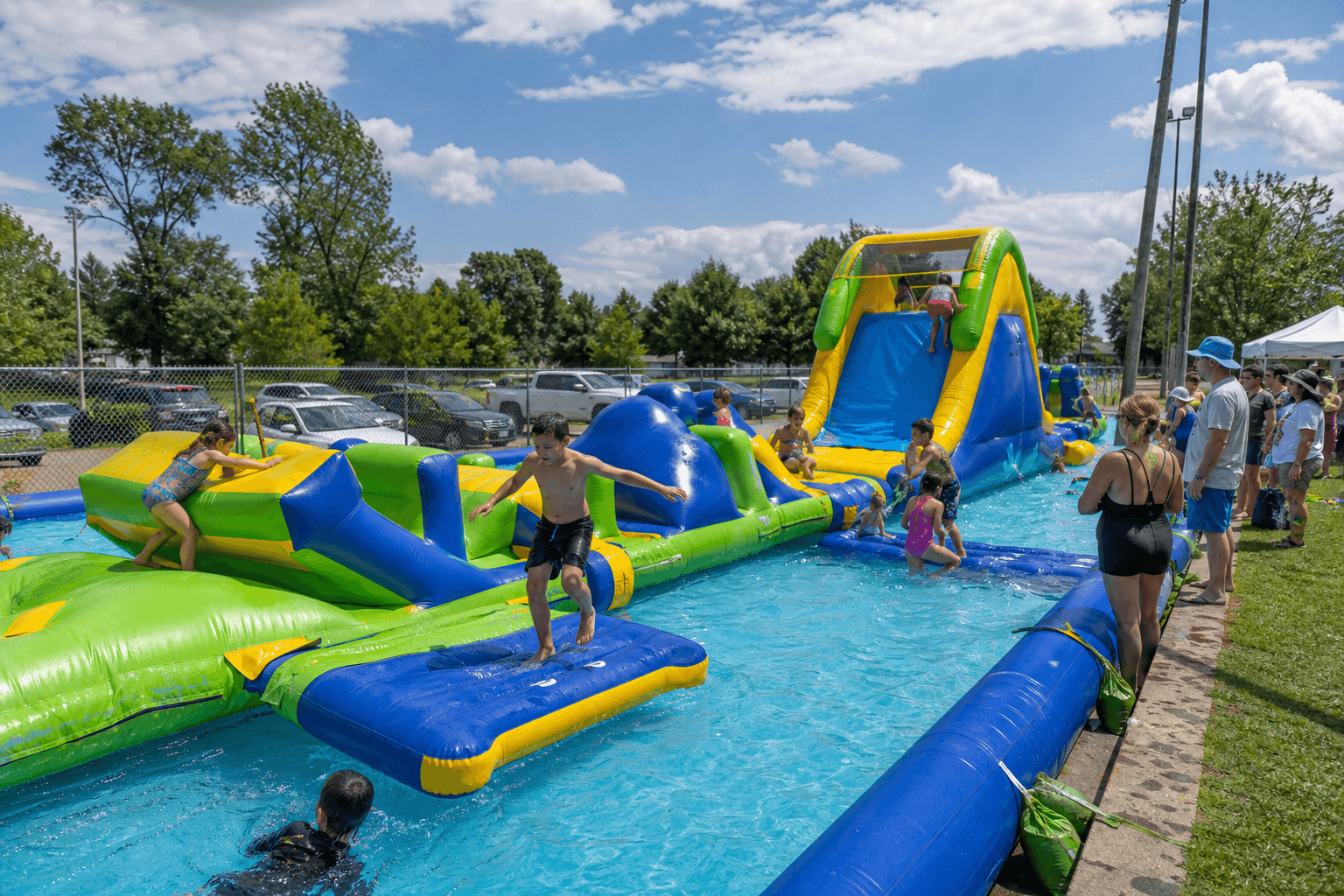
A water obstacle course is not simply a dry inflatable with a hose attached. Water changes the speed, the footing, the queue, the clothing, the drainage, and the way guests move through the rest of the event. When those details are designed well, the attraction feels like a private water park. When they are ignored, towels, mud, tangled hoses, and slippery walkways become the real theme.
Begin with the finish line
Most hosts focus on where participants enter. Start instead with where they exit: wet, excited, and often moving quickly. Give them a clear landing area, a route to towels, and a way back to the queue that does not cross food service or electrical equipment. A dual-lane course can handle competition beautifully, but only if the exit can absorb two participants at once.
Compare water slide and water-play rentals, then ask how the chosen course manages water, participant flow, and lane capacity.
Water access is only half the site plan
Confirm the hose length, water pressure, and approved connection point. Then study drainage. Runoff should not collect under the entrance, create a muddy return path, or move toward a neighbor's property. Parks, schools, and rented venues may restrict water use, so approval should come before the reservation.
The inflatable still needs a level setup area, proper anchoring, power for the blower, overhead clearance, and a workable delivery route. Keep electrical connections protected and outside the wet traffic pattern.
Choose the course for confidence, not spectacle
A tall climb and fast slide may thrill older children but discourage younger guests. For mixed-age events, use separate time blocks or select a course with features the full group can navigate. Ask about intended ages, capacity, climbing difficulty, and whether the unit is approved for wet operation.
Create a calm safety rhythm
- Place an adult at the entrance and another near the exit for busy events.
- Use short, controlled starts rather than releasing a crowd at once.
- Remove shoes, jewelry, glasses, and loose accessories.
- Keep towels, drinks, and spectators outside the runout area.
- Stop for unsafe weather, wind, or changes in inflation.
A premium water-course experience feels fast to the participant and controlled to the host. Design the exit, drainage, supervision, and recovery space with the same attention as the inflatable, and the water becomes part of the event rather than a problem to manage.
Calculate the full wet footprint
The listed inflatable dimensions do not describe the complete operating area. Add the manufacturer or provider's required clearance, anchor zones, blower space, hose routing, the participant queue, the wet exit, and a dry recovery area. A course that technically fits between two fences may still be unsuitable if attendants cannot reach both sides or if finishers have nowhere safe to slow down.
Delivery access matters as much as the final footprint. Confirm gate width, stairs, slopes, surface type, parking access, and the distance from the delivery vehicle to the setup position. Never assume a large inflatable can be carried through a narrow residential passage without provider approval.
Protect the rest of the event from water traffic
Wet guests should not have to cross the food line, gift table, electrical cords, or the main seating area. Create a transition zone with towels, footwear, drinking water, and a place for personal items. If indoor restrooms are part of the plan, protect the route so wet feet do not turn a hard floor into a slipping hazard.
Shade also belongs near the recovery zone rather than over equipment unless the provider approves the structure and placement. Guests often spend more time waiting and recovering than sliding, so comfort outside the inflatable directly affects how long the attraction remains enjoyable.
Confirm what the rental actually includes
Before comparing prices, confirm the operating package. Ask whether delivery, setup, pickup, the blower, extension equipment, hoses, attendants, and generators are included or priced separately. Verify the rental window and whether that window describes party time or the broader delivery schedule.
Photos can explain the theme, but the current listing and provider should confirm the real configuration. Ask whether the unit is designed for wet operation, whether a pool or runout is attached, how many lanes it has, and which ages or participant sizes it is intended to serve. Do not add water to a dry-only inflatable.
Use a weather decision plan
Set one adult as the contact for weather decisions and provider communication. That person should know the cancellation or rescheduling policy, the provider's wind and rain rules, and where guests will go if operation pauses. Heat plans should include drinking water and breaks; storm plans should prioritize clearing the attraction and following provider instructions.
The best water obstacle course is not automatically the tallest or longest option. It is the course that fits the property, suits the participants, drains responsibly, and can be supervised without disrupting the rest of the celebration.
Related planning guide
Continue planning with these related Bouncehouse360 guides: Water Obstacle Course, Water Slide Rental Costs: Pricing and Planning Guide, Water Obstacle Course Rental.
Related questions and planning guides
Use these related guides to compare water attractions and work through space, guest, and booking decisions.