Fleet architecture
Start with roles, not a unit count
Each purchase should solve a different demand pattern instead of duplicating the same customer.
Start with a capacity equation, not a shopping list
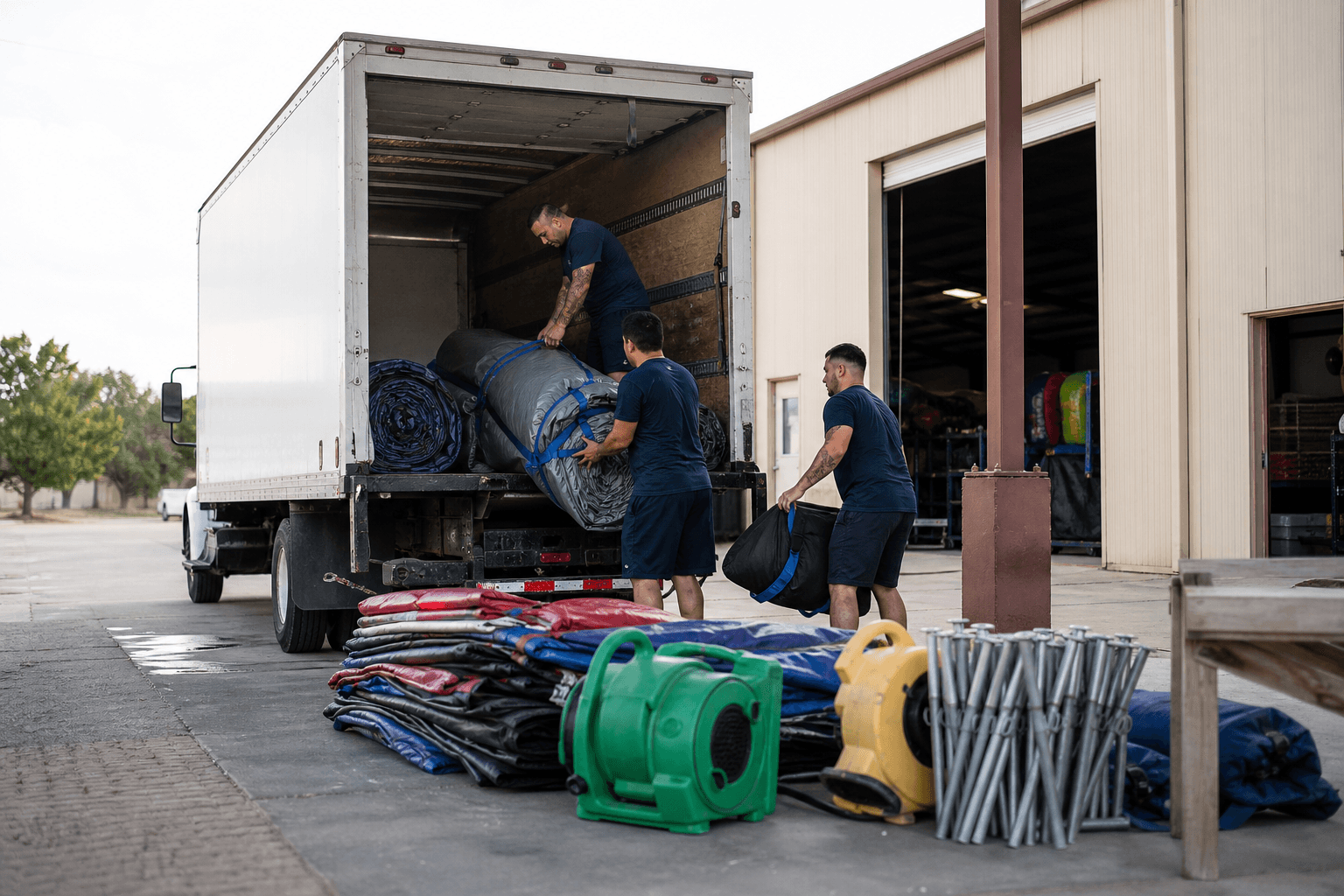
Count how many complete jobs the business can deliver, set up, inspect, pick up, clean, dry, and store during a peak weekend. One truck, one crew, and one drying area create a real ceiling. Buying beyond that ceiling turns inventory into storage cost and maintenance exposure.
Starter-fleet planning test
For every proposed unit, document the purchase cost, freight, accessories, storage footprint, vehicle space, typical setup labor, cleaning time, expected rental price, weather sensitivity, and the number of paid rentals needed to recover the investment.
Build a mix that answers different customer needs
A practical opening mix usually covers several use cases rather than several versions of the same theme. One broadly appealing bounce house can serve younger parties. A combo can support customers who want climbing and sliding in one footprint. A larger or wet-capable attraction can command a different ticket when the market and operating setup support it.
Do not treat that as a required three-unit formula. If local search data, competitor calendars, venue relationships, or paid test campaigns show stronger demand for a different category, follow the evidence. Themes can age quickly; useful formats, safe dimensions, and dependable condition generally matter longer.
Validate demand before the equipment arrives
- Interview schools, churches, venues, planners, and parents about the items they struggle to source.
- Review local search results and rental calendars to identify crowded and underserved categories.
- Build accurate draft listings and measure qualified inquiries without claiming unavailable inventory.
- Ask nearby operators whether they need overflow or subcontracting help.
- Record requested dates, ZIP codes, guest ages, surfaces, and budget ranges.
Demand is not a count of people who say an item looks fun. It is repeated interest from customers inside the service area, at a workable price, on dates the operation can serve.
Model each unit as its own small business
| Measure | What to include | Decision it supports |
|---|---|---|
| Revenue per job | Rental price and legitimate add-ons actually collected. | Whether the unit earns enough per route stop. |
| Direct job cost | Labor, fuel, cleaning, payment costs, and consumables. | Contribution before overhead and marketing. |
| Ownership reserve | Repairs, blower replacement, insurance share, and eventual retirement. | Whether apparent profit is being overstated. |
| Utilization | Paid rental days divided by rentable days. | Whether to market, reposition, or replace the unit. |
| Payback progress | Cumulative contribution compared with total landed cost. | When the unit has funded its investment. |
Use purchase gates to protect cash
Set conditions that must be met before adding another unit. Examples include a defined number of turned-away qualified requests, a sustained utilization level on comparable equipment, enough cash to buy without starving insurance or payroll, available storage, and a documented crew and vehicle plan.
Preorders and financing do not remove the operating burden. A new unit also creates photography, listing, training, inspection, repair, and marketing work. Add that workload to the decision.
Know when the fleet is too large or too small
The fleet may be too small when the same profitable request is repeatedly declined, current units are booked across multiple dates, customers accept the price, and the team can fulfill more work without weakening service. It may be too large when items sit unused, maintenance is deferred, photos and listings stay incomplete, or crews rush between too many setups.
Review the fleet monthly by contribution and quarterly by strategic role. Some units attract the first booking, some increase order value, and some serve valuable institutions. Keep a unit because its role is proven, not because it was expensive to purchase.
Compare three starter-fleet scenarios before buying
| Scenario | What it tests | Primary risk |
|---|---|---|
| One versatile unit | Whether the owner can sell, deliver, clean, and support a complete job. | One repair or booking conflict can stop all revenue. |
| Two complementary units | Whether two customer needs and two same-day jobs can be served. | Vehicle, storage, and crew capacity may be underestimated. |
| Three-unit category mix | Whether a broader offer improves conversion and route value. | Capital is spread across units before demand is proven. |
Model the cash balance after each scenario purchases equipment, accessories, insurance, storage, launch marketing, and a repair reserve. Then model a slow month, a weather-heavy month, and one damaged unit. The best starter plan is the one the business can still operate under the weaker case.
Use reservations and declined demand as evidence
Maintain a declined-demand log with the requested item, date, ZIP code, price tolerance, and reason the business could not accept the job. Separate true inventory shortages from distant addresses, impossible access, weak budgets, and dates when the entire crew was full. Only the first group is strong evidence for another unit.
A deposit-backed reservation is stronger evidence than a casual inquiry. Repeated requests from known venues are stronger than social comments. Rank evidence by how close it is to a profitable completed booking before committing cash.
Continue the operator playbook
Use the next guide that matches the constraint you are solving now:
Capital gate
What must be true before the next purchase
Use evidence from lost demand and fulfilled jobs, then confirm that operations can absorb the asset.
A practical next channel, when the operation is ready
A right-sized fleet is easier to list accurately, keep available, and fulfill reliably. Bouncehouse360 can add local marketplace visibility without asking you to replace the system that already runs your business. Approved vendors can sync existing inventory with no upfront charge, receive booking opportunities that match their service area and availability, and keep fulfilling orders through their own operation.
It is one channel, not a substitute for good pricing, safe equipment, dependable delivery, or direct customer relationships. If your listings and calendar are ready for more demand, applying is the sensible next step.
See how the vendor marketplace works
Free operator tool
Plan your party rental delivery route
Paste up to 10 delivery addresses, put the stops in a smarter order, and open the finished route in Google Maps. No vendor account is required.
Use the free route planner